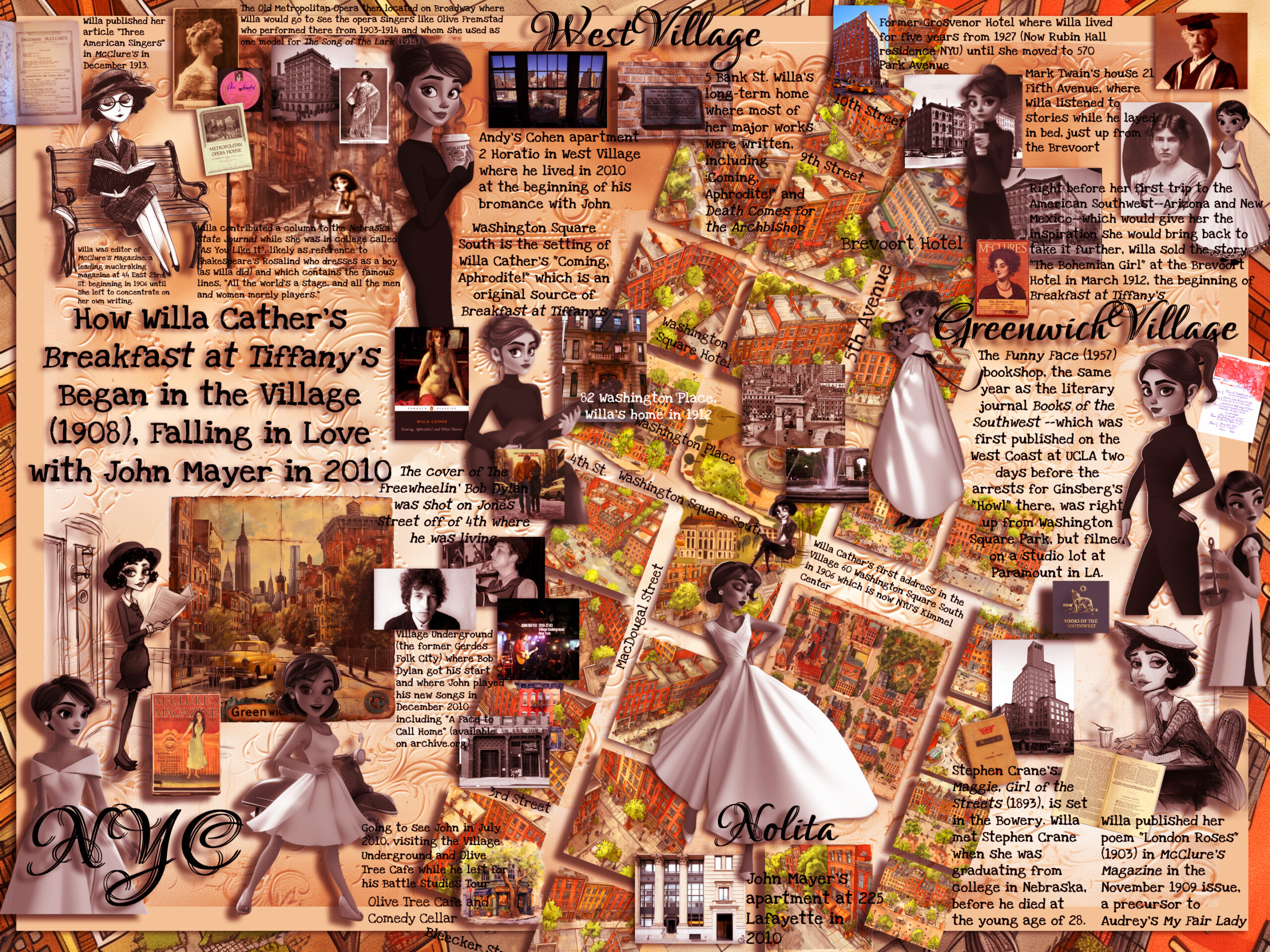
1912, Entering into the Enchanted, Quite Literally

Aujourd’hui, nous sommes le dimanche, trente novembre, deux mille vingt cinq
In 1912 Willa Cather lived in The Village off the side of Washington Square in its burgeoning bohemian literary and creative scene. She was the editor of the acclaimed muckraking McClure’s Magazine on Fourth Avenue and 20th Street, but she had something much more far-reaching in mind that she held with her with its effects and horizons flowing out of New York City and changing everything from its very core to a vision where life is experienced very differently from what had taken hold of the accepted, even widely admired (but not lived) in the Gilded Age and its industry blind rape of the wild lands and its impersonal abuses of feminine, indigenous, and immigrant–actually its very life-lines in more ways than its resources and workforce–life itself. The Triangle Shirtwaist Factory fire had just occurred in her neighborhood the spring before with young girls trapped on their floor at work having to either be consumed by flames behind locked doors or look down and jump the many stories to their deaths on the Washington Square pavement. Was this America? Its dream? The ‘Promised Land’?

A different vision, reality, was always desperately needed, stemming from the liminal to its center, and Willa was that different kind of Being.

Creation is the realm of the artist, especially the divine artist. And wildly, they can open it.

That cultural arrogance held closed, self-contorted, almost self-incestuous visions of hoarded statues from raped gold made in images of themselves with the reality being real bodies mangled on the railroads. It was an unseen cultural dead end of this gorgeous continent and what the dream of it actually was for so many, not uninspired capitalist consumption. Certainly the American Revolution and Civil Wars had not courageously sacrificed so many hundreds of thousands of young men’s bodies to be slaughtered for those limited visions. Willa had always been a deep thinker and cultural boundary-crosser. She was about to find the way to shape her long thought-out vision into very real existence, her own existence as she must, as tenuous as it feels to leave the jobs of teaching and then editing behind, but one must if the soul demands its broader fire inspiration illuminate, and she was headed for the American Southwest.
As she was packing to leave she met at the cafe of the Brevoort Hotel, visible right up from Washington Square Arch up Fifth Avenue, with the interim editor of McClure’s who was taking her place. She wasn’t trying to sell her story, “The Bohemian Girl,” but he wanted it. It was the end of February 1912. It was the perfect beginning for this trip into her own feminine wild blue yonder. Let the writer go see! Ten years earlier she had gone by ship to France for the first time, her life-long cultural and literary inspiration. What could the American Southwest offer beyond the cultivation of the centuries-refined life-affirming lines of tradition of authentic birthright to pleasure and joy and its immaculate care where each occasion celebrates the secular rituals dedicated to the togetherness and the humanistic?

That very question opens up the magic of what she would find true and real and waiting for her own expression. The American Southwest was going to tell her.

New Mexico entered statehood in January 1912 just as she was readying her plans. Her state-hood was coming. She was first going to Winslow, Arizona by train to join up with her brother and adventure on the terrain there first. Each step of the trip was momentously, naturally opening the reality of her inspiration in these boundaries beyond her own childhood wild and free natural Nebraska (making her sensitive to the terrain’s changing personality and emanation of expression speaking to her), and this would culminate in New Mexico when she saw the path of how to deliver herself and her vision in this landscape. The United States of America is in its most gorgeous, formidable, and realist sense its geographical terrain and what it emanates that most autonomously, naturally doesn’t hear outside voice, opinion, and intrusion so far away because it already knows itself through its millennia of vast solidity, realness, and stillness and staggering natural grandeur and depth. The approach to that landscape and relation of self to it and the stance towards its inhabitants is a revelation of arrival and what its eternalness in form reveals. One is not a spectator, but a participant.

It is the same if one sits in personal communion with Leonardo da Vinci’s The Virgin of the Rocks for her soft, immovable revelation. She knows who she is and a cathedral is only somewhat grandly just mimetic to gather, isolate, and lift the soul in incapsulated mimetic ritual to get close to this feeling. Here is the real experience, the real identity in solidity of fact and place, and with it the possibility of the real life orgasmic realization in the everyday.

How Willa could know this is her own life-long study and relationship with French and Italian inspiration that opened to her as a child and student–art, literature, heritage, and culture, but then also being in America and feeling the absence of one’s own place and realization, even feeling the displacement (except she knew how to be transplanted and to find the deeper truths of place beyond the common cultural thought), and the reality evident to her and rising up all along in her soul, willing itself from the fervent depths to articulate precise expression, arbitrarily formerly disallowed, arbitrarily with no allotted room, space, or time for it for “more important” endeavors of an American culture emptying itself by its appetite, but never knowing the gorgeous peace of satiety, well-being, joy, immersion in what Willa was seeing as a very different emanation of reality. Thus the lineage of art, the flow of the body of life, was being strangled to her instead of delivered to this phenomenal continent–already peopled with expression of sacred Place, and here was this female determined to know herself and live that life-giving line and open it. She very carefully was examining its most formidable modes of transmission that would deliver this life through her creations.

The Transmutation in Place

It was as seemingly ‘simple’ as the placement of one’s feet on the bare rock and feeling the solidity in the body and mind, and like the rocks, what had arrived to this continent culturally outside of the Beingness is silenced, far away, America’s definition from lesser minds remote. A different strength, a different kind of freedom, a different wildness of spirit (not reactive, but of its self–and that leads true revolutions) is known, a different, more true voice. And then there is the fire of inspiration from there, not exploitative in the least, but Place revealing itself in state of pure Being, its attributes of Place evident and speaking. Importantly, others from this Place had lived here hundreds of years before and left their own tell-tale remnants of what they expressed and what mattered most to express in their existences in form, in this landscape of form, form and transcendence.
Another aspect of this is what will open when one steps into that Being reality where one can examine inside the stillness, and thus outside which automatically turns into a different Place. Willa articulated this transition in her 1915 The Song of the Lark from her experience there at Walnut Canyon outside of Flagstaff. She had arrived to her own space and expression from this core of Being and could now examine the flow of culture and that it most certainly could be changed from which it came–what had arrived to America and how it had gone thus far feeding from appetite (a sign of merely mortal form, as forewarned by the ancients) (appetite for money, fame, attention, etc. is the tell-tale of inner empty shell as it seeks outside of its ghost self).
The line of art came from France and Italy, its ‘religion’ and legends expressed there to its fullest divine beauty from Florence and Rome to Paris and Marseilles. But importantly here in the American Southwest was also the freedom of the absence of what had been built up around the guarding of it in Rome into structure (the obtrusive walls even Dante experienced) and the not-yet-fully transmuted transmission of the inheritance of Jerusalem that had been strangled there by war and politics and thus had artistically, spiritually, and physically in relics migrated to the draw of life, for the inspiration of life, to the very sensuous arms of the Bouches-du-Rhône where She, the Magdalene, desired most to live.

Willa Sees It

Much has been documented about Willa’s experiences in the Southwest and her literary inspiration, as from her life-partner Edith Lewis, but what isn’t seen is within the unspoken lightning-strike moments wherein this Place was speaking, as it does when one has entered into it, with it, at its insistence, in Beingness (and not mind dominated that can be full of conditioned beliefs and thus arbitrarily applied vision of place and self, an imposition, a suffering as opposed to an illumination). In this way it is very much akin to entering into the ‘land of the dead’, the literal “Jornada del Muerto,” the “Dead Man’s Journey,” wherein the on-the-road travel induces the letting go of self and going into this in-between life and death, form and out-of form. Right in the middle of two coasts, it is likely the most liminal of places, the balance between, because it isn’t dead in too far-off reaches, forgotten, powerless, silent, but at the continent’s heart; nor does it seek life from uninspired existence but does spread its wings, its reaches and powerful expanse of Beingness rippling out, and does finally arrive to inspired form from the source of its own isolation. It is naturally on its own, but connected to everything. But if one tried to deliver its realization and reaches as form only, and to American’s economy-minded “culture,” as Willa demonstrated in “Tom Outland’s Story,” it would be completely lost on “them” and they’d send its form off to be slaughtered in war and take the receipts to the bank, blind to the true transmission and inheritance.
As Willa showed later in her Death Comes for the Archbishop in 1927, this Place was already speaking to her what was at the heart of it once she had entered this Pure Land in this way. What we can surmise now is the moment she saw the direct line of La Madeleine arriving–at the Moment of seeing herself, unpredictably (until one sees its exactness and then it is all of blessed, magical, and inevitable, yet exists alive to be experienced only in the hard-to-know Present Moment, that participation with the Pure Land), and from the protected cove of France. It must have come as a shock to Willa’s system the moment she saw in reality what she already knew, and that it was telling her what she already surmised was far more real when she saw that the first Archbishop of the entire vast expanse of the Southwest all the way to California was directly from France, the line of art, the line of legend, the line of life itself as she already knew. But not only that, but that the entire line of the first five Archbishops of this territory “of momentous things” seated in Santa Fe were the line from France. The truth was in her hands. She had to figure out how to deliver it. How does art transmit its eternal alive reality? Its eternal self? It was moving to form. And here she was being shown how it was already in natural motion and arrival, the instant she saw it.

“Serendipitous” and “uncanny,” that is, in the human thought dimension of “what can be known,” but pure perfection into human form in the broader scope, most certainly by its very evidence unbound to that limited thought, but beyond beautiful either way. It breaks open the tremendous. It is far more the realer dimension of cosmic perfection breaking through.

Scroll to Top