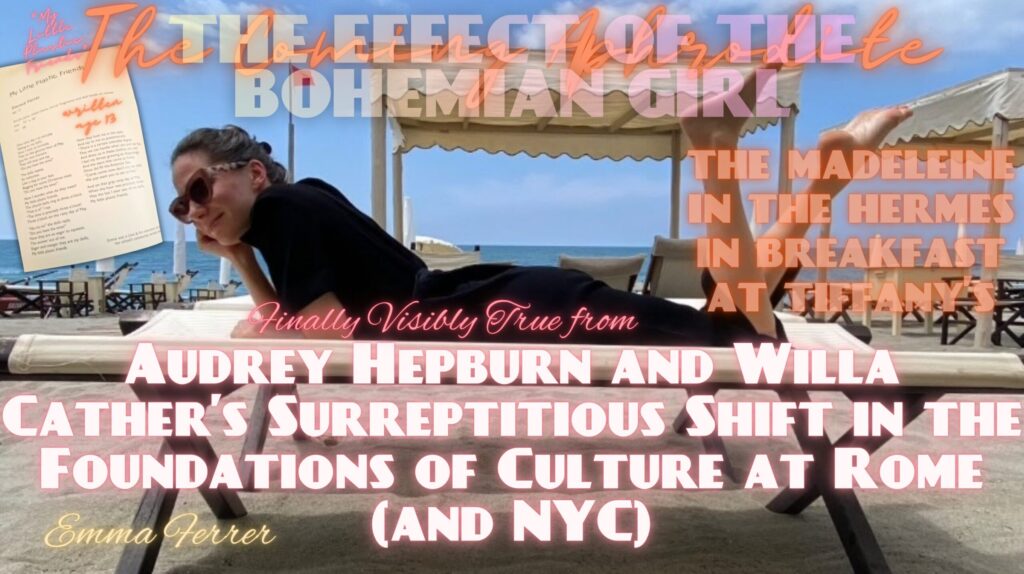
Finally Visably True from Audrey Hepburn and Willa Cather’s Surreptitious Shift in the Foundations of Culture at Rome (and NYC)
THE MADELEINE(S) IN THE HERMES IN BREAKFAST AT TIFFANY’S
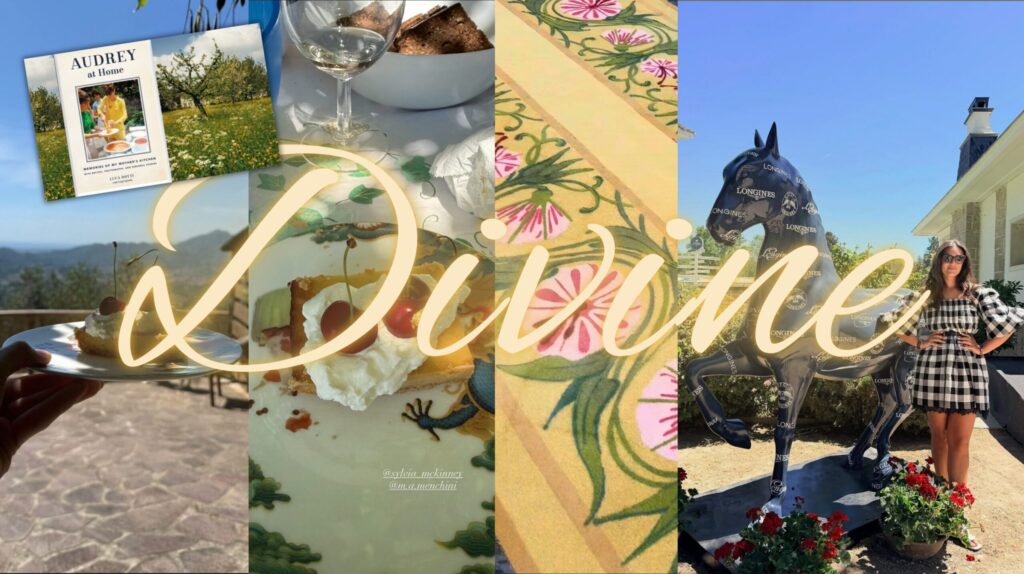
Emma Ferrer fortuitously on the shores of Italy.
Emma Ferrer’s “My Little Plastic Friends” published at age 13.
emmaferrer.com “‘Tender yet haunting – with profound empathy on display’ — Vogue”
No algorithm forcing contention necessary to change everything.
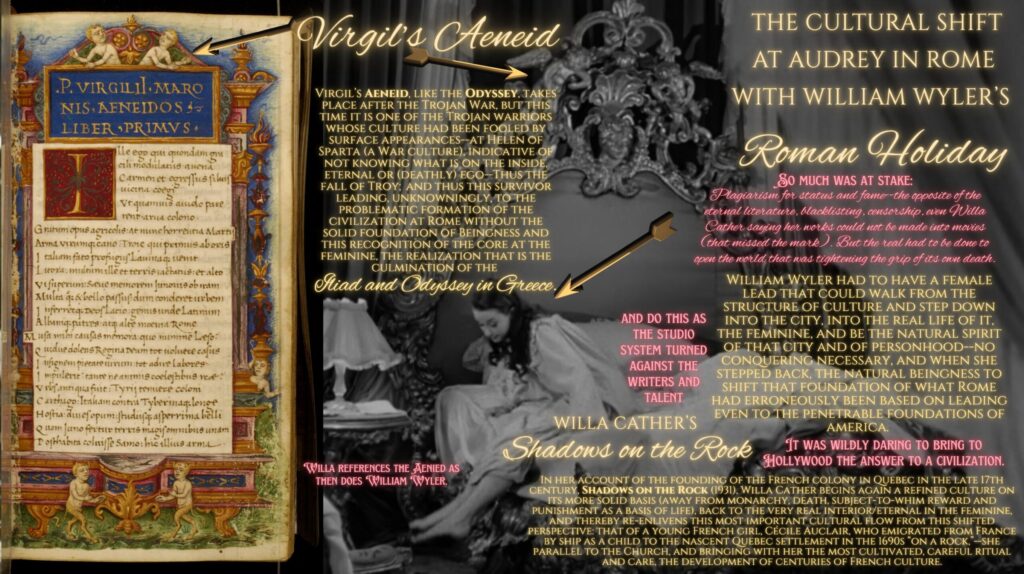
The Cultural Shift at Audrey in Rome with William Wyler’s Roman Holiday
Virgil’s Aeneid, like the Odyssey, takes place after the Trojan War, but this time it is one of the Trojan warriors whose culture had been fooled by surface appearances–at Helen of Sparta (a war culture), indicative of not knowing what is on the inside, eternal or (deathly) ego–Thus the fall of Troy; and thus this survivor leading, unknowningly, to the problematic formation of the civilization at Rome without the solid foundation of Beingness and this recognition of the core at the feminine, the realization that is the culmination of the Iliad and Odyssey in Greece.
For director William Wyler, So much was at stake: Plagiarism for status and fame–the opposite of the eternal literature; blacklisting, censorship, even Willa Cather saying her works could not be made into movies (that missed the mark). But the real had to be done to open the world that was tightening the grip of its own death.
William Wyler had to have a female lead that could walk from the structure of culture and step down into the city, into the real life of it, the feminine, and be the natural spirit of that city and of personhood–no conquering necessary, and when she stepped back, the natural beingness to shift that foundation of what Rome had erroneously been based on leading even to the penetrable foundations of America.
It was wildly daring to bring to Hollywood the answer to a civilization. And do this as the studio system turned against the writers and talent.
In her account of the founding of the French colony in Quebec in the late 17th century, Shadows on the Rock (1931), Willa Cather begins again a refined culture on its more solid basis (away from monarchy, death, subject-to-whim reward and punishment as a basis of life), back to the very real interior/eternal in the feminine, and thereby re-enlivens this most important cultural flow from this shifted perspective: that of a young French girl, Cécile Auclair, who emigrated from France by ship as a child to the nascent Quebec settlement in the 1690s “on a rock”–she parallel to the Church, and bringing with her the most cultivated, careful ritual and care, the development of centuries of French culture.
Willa alludes to the Aenied as then does William Wyler.
Nicole Kidman, June 2026
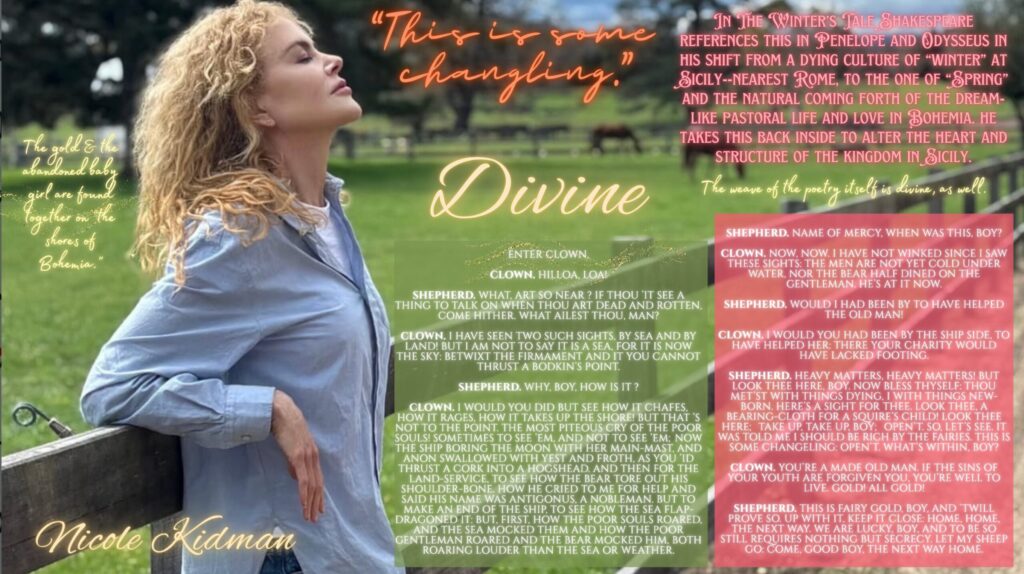
Divine.
“This is some changeling.”
In The Winter’s Tale Shakespeare references this in Penelope and Odysseus in his shift from a dying culture of “winter” at Sicily–nearest Rome, to the one of “Spring” and the natural coming forth of the dream-like pastoral life and love in Bohemia. He takes this back inside to alter the heart and structure of the kingdom in Sicily.
The weave of the poetry itself is divine, as well.
The gold & the abandoned baby girl are found together on “the shores of Bohemia.”
The Winter’s Tale from Act III, Scene III
Enter Clown.
Clown. Hilloa, loa!
Shepherd. What, art so near ? If thou ’It see a thing to talk on when thou art dead and rotten, come hither. What ailest thou, man?
Clown. I have seen two such sights, by sea and by land! but I am not to say it is a sea, for it is now the sky: betwixt the firmament and it you cannot thrust a bodkin’s point.
Shepherd. Why, boy, how is it ?
Clown. I would you did but see how it chafes, how it rages, how it takes up the shore! but that ’s not to the point. the most piteous cry of the poor souls! sometimes to see ’em, and not to see ’em;now the ship boring the moon with her main-mast, and anon swallowed with yest and froth, as you ’Id thrust a cork into a hogshead. And then for the land-service, to see how the bear tore out his shoulder-bone. how he cried to me for help and said his name was Antigonus, a nobleman. But to make an end of the ship, to see how the sea flap-dragoned it: but, first, how the poor souls roared, and the sea mocked them and how the poor gentleman roared and the bear mocked him, both roaring louder than the sea or weather.
SHEPHERD. Name of mercy, when was this, boy?
CLOWN. Now, now. I have not winked since I saw these sights: the men are not yet cold under water, nor the bear half dined on the gentleman. He’s at it now.
SHEPHERD. Would I had been by to have helped the old man!
CLOWN. I would you had been by the ship side, to have helped her: there your charity would have lacked footing.
SHEPHERD. Heavy matters, heavy matters! But look thee here, boy. Now bless thyself: thou met’st with things dying, I with things new-born. Here’s a sight for thee. Look thee, a bearing-cloth for a squire’s child! Look thee here; take up, take up, boy; open’t. So, let’s see. It was told me I should be rich by the fairies. This is some changeling: open’t. What’s within, boy?
CLOWN. You’re a made old man. If the sins of your youth are forgiven you, you’re well to live. Gold! all gold!
SHEPHERD. This is fairy gold, boy, and ’twill prove so. Up with it, keep it close: home, home, the next way. We are lucky, boy, and to be so still requires nothing but secrecy. Let my sheep go: come, good boy, the next way home.
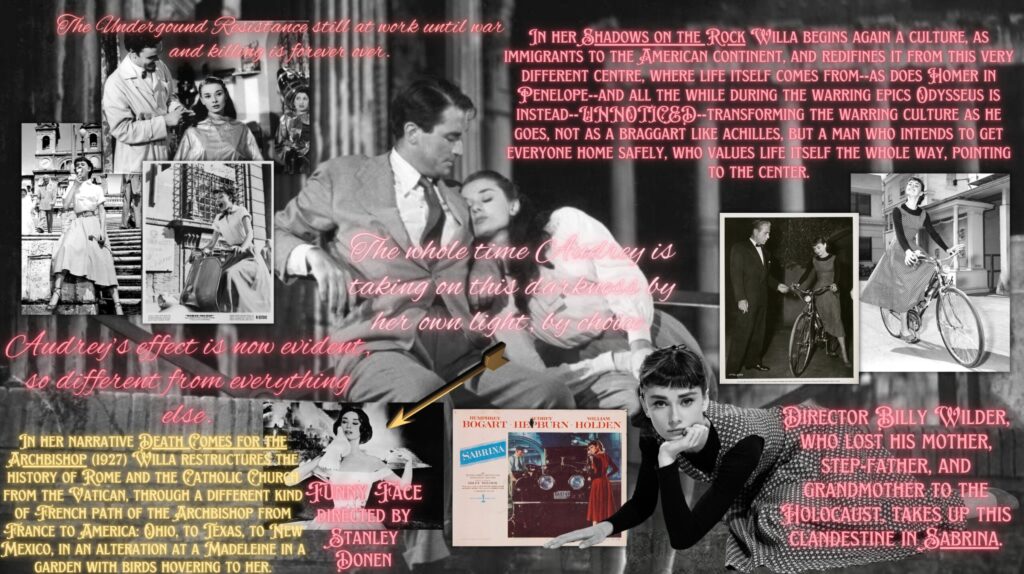
The Undergound Resistance still at work until war and killing is forever over.
Audrey’s effect is now evident, so different from everything else.
The whole time Audrey is taking on this darkness by her own light, by choice.
In her Shadows on the Rock Willa begins again a culture, as immigrants to the American continent, and redifines it from this very different centre, where life itself comes from–as does Homer in Penelope–and all the while during the warring epics Odysseus is instead–UNNOTICED–transforming the warring culture as he goes, not as a braggart like Achilles, but a man who intends to get everyone home safely, who values life itself the whole way, pointing to the center.
Director Billy Wilder, who lost his mother, step-father, and grandmother to the Holocaust, takes up this clandestine in Sabrina (1954).
Just as Funny Face (1957) directed by Stanley Donen.
In her narrative Death Comes for the Archbishop (1927) Willa restructures the history of Rome and the Catholic Church from the Vatican, through a different kind of French path of the Archbishop from France to America: Ohio, to Texas, to New Mexico, in an alteration at a Madeleine in a garden with birds hovering to her.
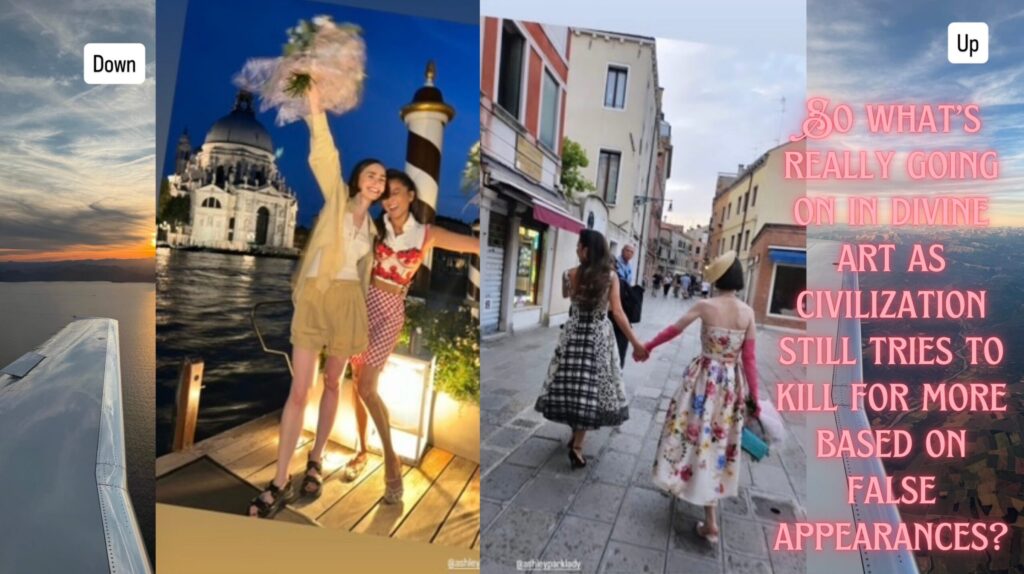
Lily Collins and Ashley Park
So what’s really going on in divine art as civilization still tries to kill for more based on false appearances?
Lily Collins, Ashley Park, and Lucien Laviscount in Greece.
You only think you’re “just watching” Emily in Paris.
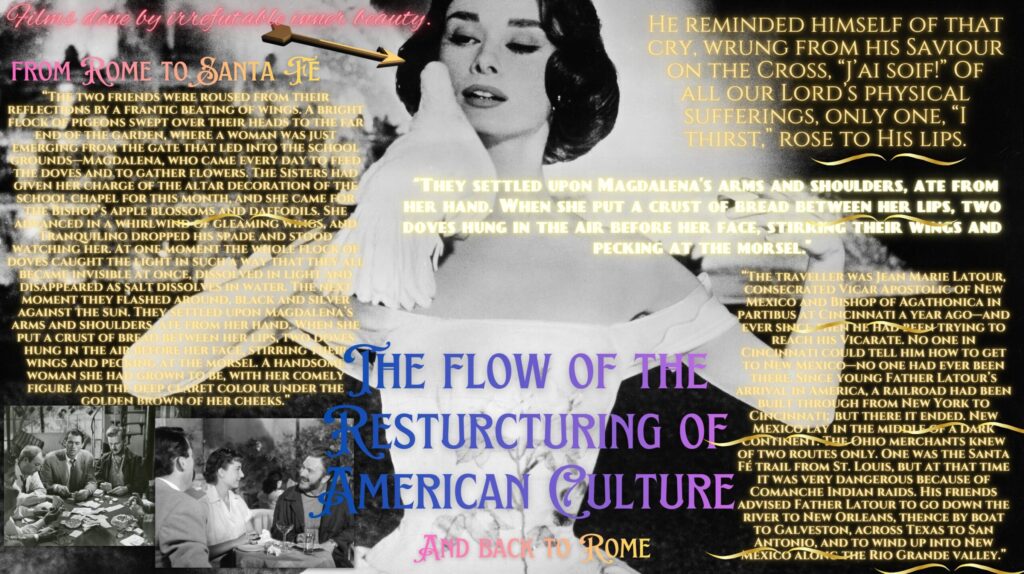
The Flow of the Resturcturing of American Culture and Back to Rome
Audrey’s films are done by irrefutable inner beauty.
“He reminded himself of that cry, wrung from his Saviour on the Cross, ‘J’ai soif!’ Of all our Lord’s physical sufferings, only one, ‘I thirst,’ rose to His lips.”
from Death Comes for the Archbishop
“They settled upon Magdalena’s arms and shoulders, ate from her hand. When she put a crust of bread between her lips, two doves hung in the air before her face, stirring their wings and pecking at the morsel.”
“The traveller was Jean Marie Latour, consecrated Vicar Apostolic of New Mexico and Bishop of Agathonica in partibus at Cincinnati a year ago—and ever since then he had been trying to reach his Vicarate. No one in Cincinnati could tell him how to get to New Mexico—no one had ever been there. Since young Father Latour’s arrival in America, a railroad had been built through from New York to Cincinnati; but there it ended. New Mexico lay in the middle of a dark continent. The Ohio merchants knew of two routes only. One was the Santa Fé trail from St. Louis, but at that time it was very dangerous because of Comanche Indian raids. His friends advised Father Latour to go down the river to New Orleans, thence by boat to Galveston, across Texas to San Antonio, and to wind up into New Mexico along the Rio Grande valley.”
From Rome to Santa Fé
“The two friends were roused from their reflections by a frantic beating of wings. A bright flock of pigeons swept over their heads to the far end of the garden, where a woman was just emerging from the gate that led into the school grounds—Magdalena, who came every day to feed the doves and to gather flowers. The Sisters had given her charge of the altar decoration of the school chapel for this month, and she came for the Bishop’s apple blossoms and daffodils. She advanced in a whirlwind of gleaming wings, and Tranquilino dropped his spade and stood watching her. At one moment the whole flock of doves caught the light in such a way that they all became invisible at once, dissolved in light and disappeared as salt dissolves in water. The next moment they flashed around, black and silver against the sun. They settled upon Magdalena’s arms and shoulders, ate from her hand. When she put a crust of bread between her lips, two doves hung in the air before her face, stirring their wings and pecking at the morsel. A handsome woman she had grown to be, with her comely figure and the deep claret colour under the golden brown of her cheeks.”
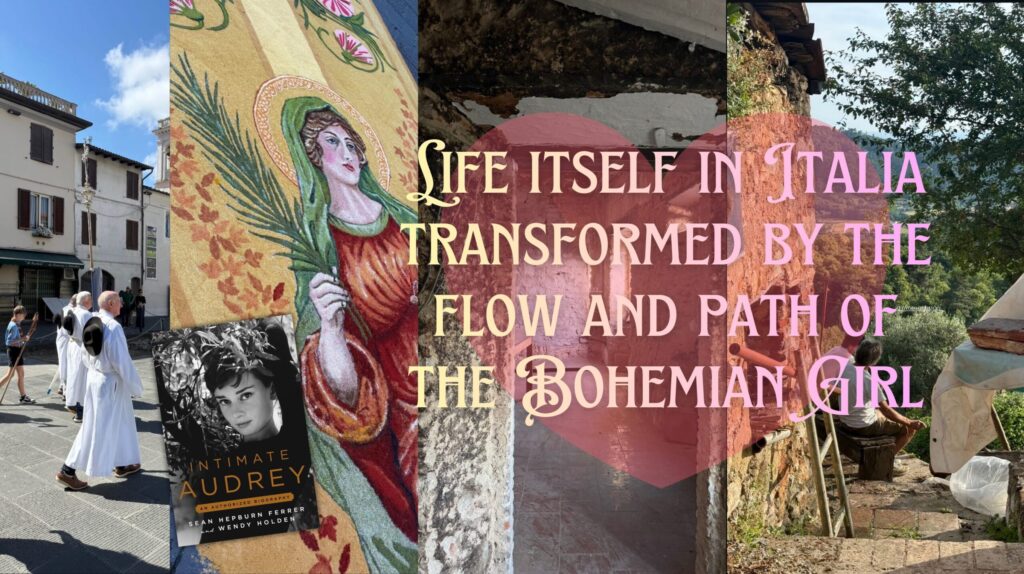
Life itself in Italia transformed by the flow and path of the Bohemian Girl.
Athena Hepburn in Spain
Divine.
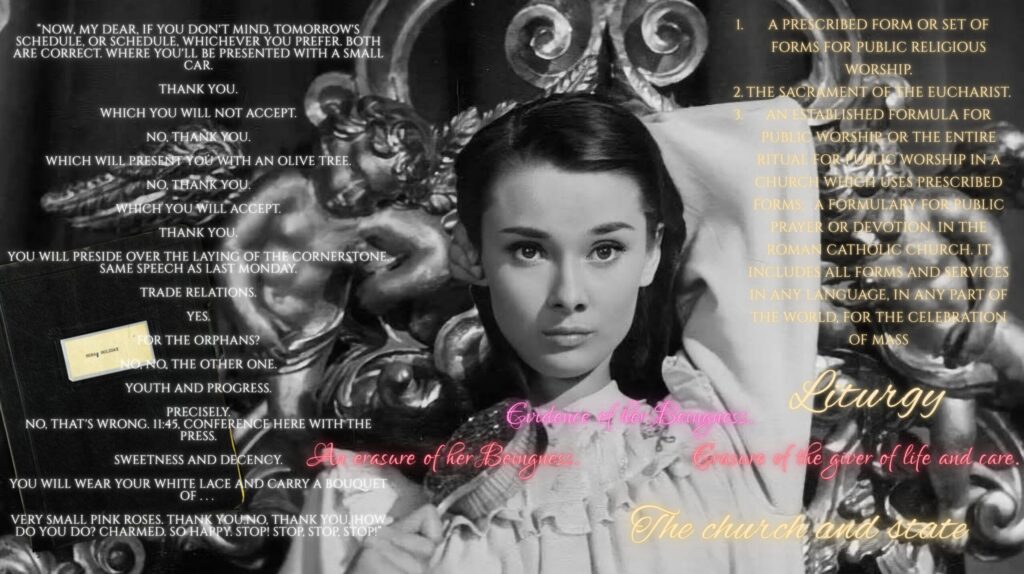
Evidence of her Beingness.
An Erasure of Her Beingness:
“Now, my dear, if you don’t mind, tomorrow’s schedule, Or schedule, Whichever you prefer. Both are correct. where you’ll be presented with a small car.
Thank you.
Which you will not accept.
No, thank you.
Which will present you with an olive tree.
No, thank you.
Which you will accept.
Thank you.
You will preside over the laying of the cornerstone. Same speech as last Monday.
Trade relations.
Yes.
For the orphans?
No, no, the other one.
Youth and progress.
Precisely.
No, that’s wrong. 11:45, conference here with the press.
Sweetness and decency.
You will wear your white lace and carry a bouquet of . . .
Very small pink roses. Thank you.No, thank you.|How do you do? Charmed. So happy. Stop! Stop, stop, stop!”
from Roman Holiday (1953)
Erasure of the giver of life and care.
“A prescribed form or set of forms for public religious worship.”
“The sacrament of the Eucharist.”
“An established formula for public worship, or the entire ritual for public worship in a church which uses prescribed forms; a formulary for public prayer or devotion. In the Roman Catholic Church. it includes all forms and services in any language, in any part of the world, for the celebration of Mass.”
Liturgy.
The Church and State.
Willa Cather structures the different culture on the arrival of the Bohemian girl–both immigrant & La Bohème from the South of France.
She shows this different kind of spirit, approach, This French/Bohemian Path coming to the American continent from
My Ántonia
Shadows on the Rock
Death Comes for the Archbishop
“The Bohemian Girl”
Willa actually finds the delivery of this magic of spirit all the way from the arrival to the realization in her body.
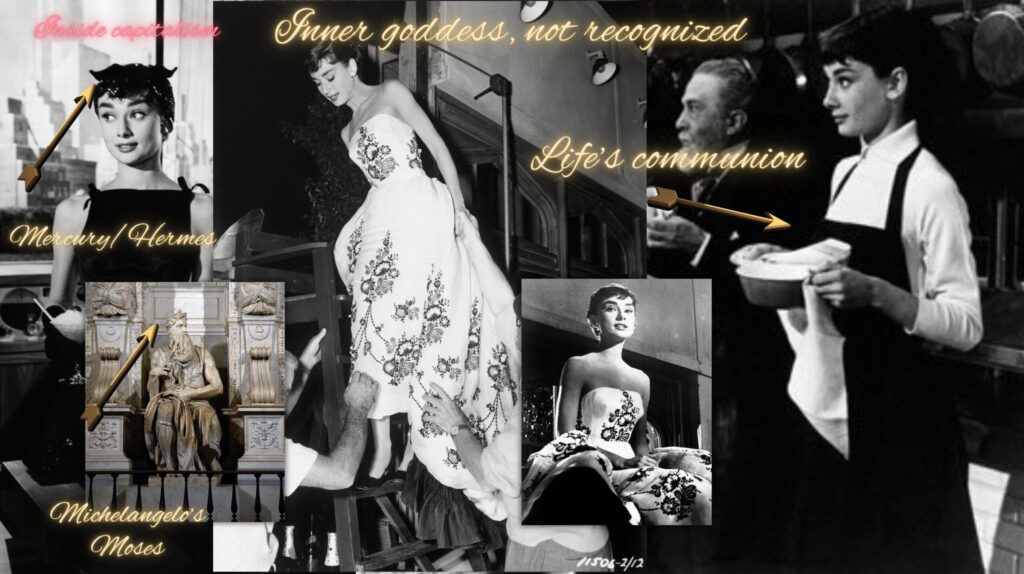
Inner goddess, not recognized.
Life’s communion.
Inside capitalism.
Mercury/Hermes
Michelangelo’s Moses
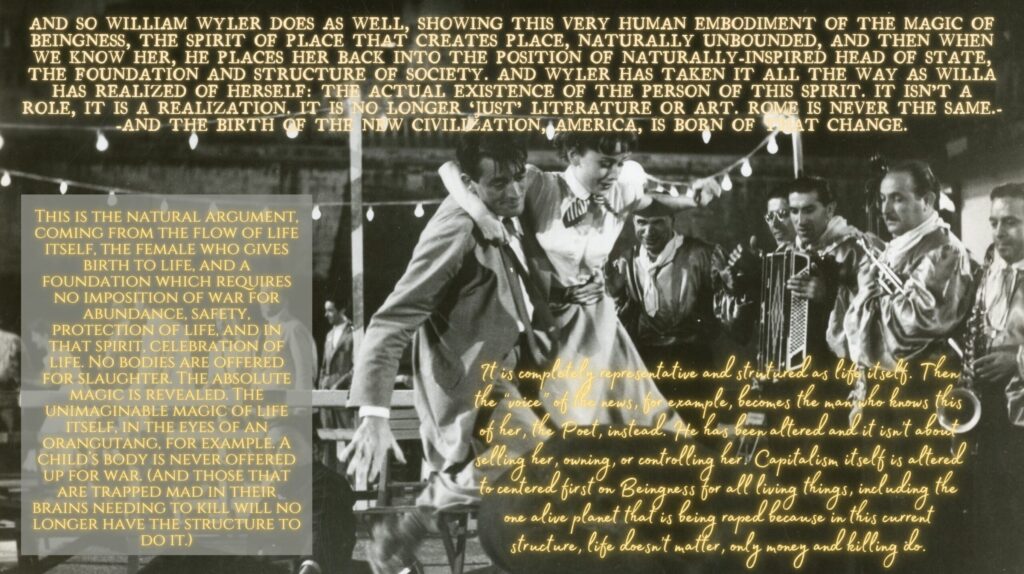
And so William Wyler does as well, showing this very human embodiment of the magic of beingness, the spirit of place that creates place, naturally unbounded, and then when we know her, he places her back into the position of naturally-inspired head of state, the foundation and structure of society. And Wyler has taken it all the way as Willa has realized of herself: the actual existence of the person of this spirit. It isn’t a role, it is a realization. It is no longer ‘just’ literature or art. Rome is never the same–and the birth of the new civilization, America, is born of that change.
It is completely representative and strutured as life itself. Then the “voice” of the news, for example, becomes the man who knows this of her, the Poet, instead. He has been altered and it isn’t about selling her, owning, or controlling her. Capitalism itself is altered to centered first on Beingness for all living things, including the one alive planet that is being raped because in this current structure, life doesn’t matter, only money and killing do.
This is the natural argument, coming from the flow of life itself, the female who gives birth to life, and a foundation which requires no imposition of war for abundance, safety, protection of life, and in that spirit, celebration of life. No bodies are offered for slaughter. The absolute magic is revealed. The unimaginable magic of life itself, in the eyes of an orangutang, for example. A child’s body is never offered up for war. (And those that are trapped mad in their brains needing to kill will no longer have the structure to do it.)
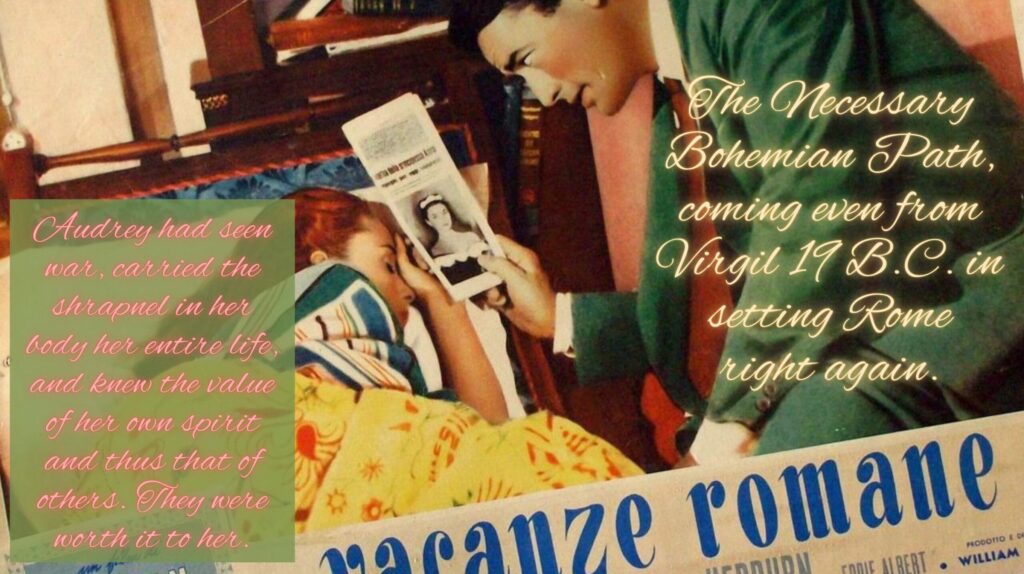
The necessary Bohemian path, coming even from Virgil 19 B.C. in setting Rome right again.
Audrey had seen war, carried the shrapnel in her body her entire life, and knew the value of her own spirit and thus that of others. They were worth it to her.